Using the Wheelchair as a Seat in a Vehicle
You can use your wheelchair to travel as an occupant in a vehicle approved for this purpose while remaining seated in the wheelchair.
Transport only in the default position
Make sure that no components are raised or tilted.
During development, the following two types of vehicle were particularly taken into account:
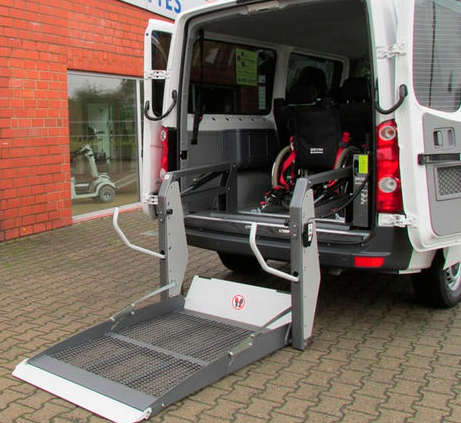 (a) Lifting platform | 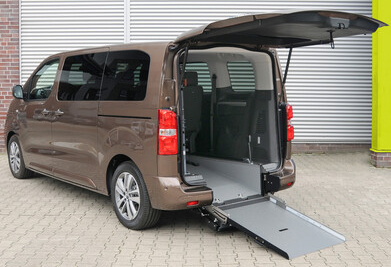 (b) Rear cut-out |
Vehicles with lifting platform / flat loading floor / buses (e.g. Mercedes Sprinter or Fiat Ducato)
Vehicles with rear cut-out
The following images show how the straps are correctly attached to the wheelchair.
For the rear securement, use two straps that are approved in accordance with ISO 10542-1 for wheelchairs up to at least 200 kg (e.g. QRT-550 from Q'Straint).
For the front securement, use two straps that are approved in accordance with ISO 10542-1 for wheelchairs up to at least 160 kg (e.g. QRT-Deluxe from Q'Straint).
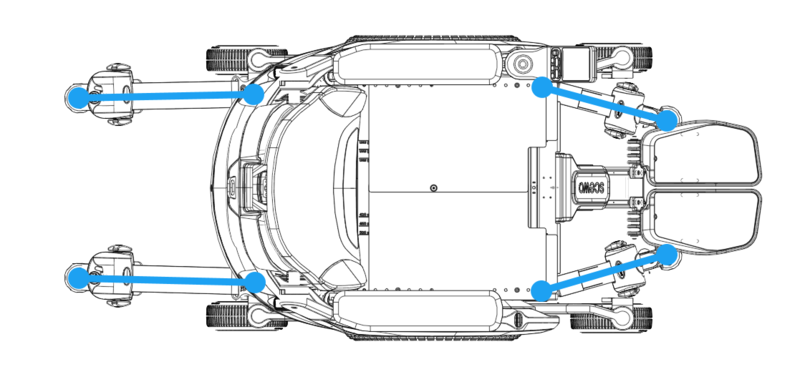 |
The device must be secured at the rear with 2 straps (up to 200 kg) and at the front with 2 straps (up to at least 160 kg).
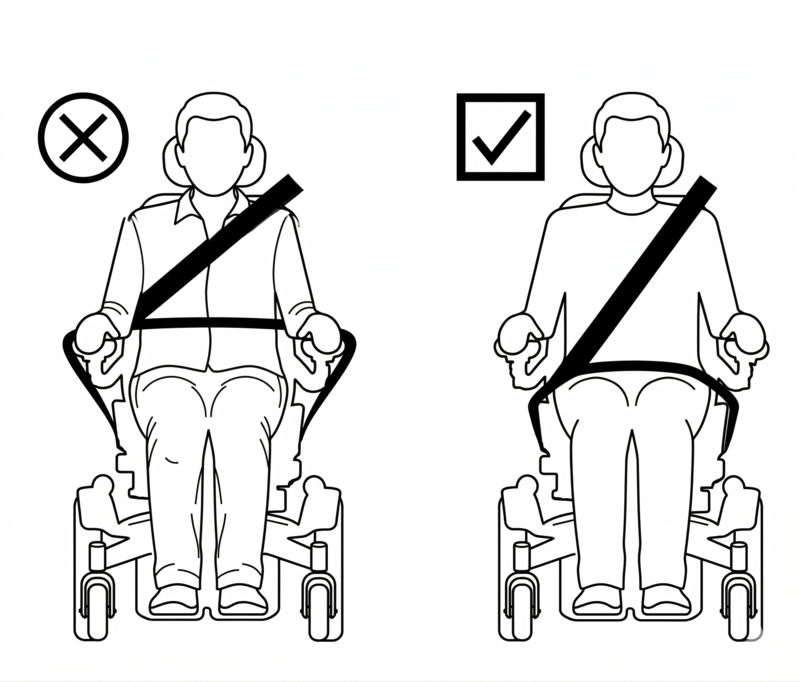
Make sure that the belt fastenings are tightened as firmly as possible without becoming uncomfortable, and that they are not twisted. They must fit snugly against your body and must not be held away from it by parts of the wheelchair. Adjust your restraint system so that the release mechanisms cannot be triggered in an accident. The shoulder belt should run across the middle of your shoulder. The pelvic belts should sit low and snug against your pelvis and ideally be routed at an angle of 30° to 75°. A steeper angle between 45° and 75° to the horizontal is preferable. Make sure that no components of your wheelchair are raised or tilted.
 |
The following instructions must be observed when the wheelchair is used as a seat in a vehicle:
General safety instructions for transporting the wheelchair as a car seat for occupants
When used as a car seat for occupants in a motor vehicle, the wheelchair may only be transported facing forwards.
The vehicle must be suitably designed, insured and equipped to transport a person in a wheelchair. If the wheelchair is transported in a vehicle as a car seat with an occupant, the vehicle must meet the requirements of ISO 7176-19:2008 and the straps must comply with ISO 10542-1:2012.
Whenever possible, transfer to the vehicle's designated seating and stow the wheelchair securely in the luggage area. No matter how securely a wheelchair is fastened in the vehicle, it is not designed as a car seat and cannot provide the same level of safety as standard car seats.
Before transport, check that the wheelchair has been secured correctly and that both brakes are locked. Secure the wheelchair to the vehicle at the front and rear only at the securement points (marked by stickers). Follow the manufacturer's instructions supplied with the approved tie-down straps.
Only use wheelchair accessories that are approved for use in a vehicle (e.g. back cushions). Remove any non-approved accessories before transport.
Make sure that no components accidentally press the release button of the belt buckle or the freewheel.
If the wheelchair has been involved in a road traffic accident, return it immediately to the partner or manufacturer for inspection. Safe operation and safety in a further accident cannot be guaranteed.
Only use the wheelchair as a seat facing the direction of travel
If the wheelchair is used as a car seat for occupants, it MUST face in the direction of travel. Any other orientation of the wheelchair (e.g. sideways or backwards) is NOT permitted and is life-threatening for the occupant and other passengers.
Use sufficiently strong, tested straps!
It is mandatory to use a total of 4 straps!
The two rear straps must be tested in accordance with ISO 10542-1 and approved for wheelchairs up to 200 kg (e.g. QRT-550 from Q'Straint).
The two front straps must be tested in accordance with ISO 10542-1 and approved for wheelchairs up to at least 160 kg (e.g. QRT-Deluxe from Q'Straint).
Positioning aids such as the pelvic belt do not replace the seat belt!
The Positioning aids of the wheelchair are intended to position the user in the wheelchair so that it can be used safely. They offer no protection in a road traffic accident and cannot replace the seat belt installed in the vehicle.
Therefore, always use the restraint systems provided by the vehicle, preferably a three-point seat belt. The pelvic belt integrated in the wheelchair is not approved or designed for use in a vehicle and can tear in an accident!
Fasten the seat belt correctly
The correct position of the three-point seat belt is on the inside of the wheelchair's arm support. The three-point seat belt must fit snugly against the user's body with nothing in the way. If the three-point seat belt is not positioned correctly, this can lead to injury and/or death if the vehicle is involved in an accident.
Securing the back cushion
Each time before using the wheelchair as a seat in a vehicle, check that your back cushion is secured with the knurled screw, otherwise the cushion can come loose in an accident.