Car Passenger Mode
New from BRO software version 22.5.9.
This function is available only from BRO software version 22.5.9. This mode is not available on BROs with earlier software versions. Please perform an update.
Recommended pelvic belt
We recommend a certified pelvic belt measuring at least 320 cm in length (XL version, e.g. Art-Nr. H 450 198 made by AMF Bruns). The pelvic belt is attached to the vehicle’s restraint system directly. Since not all driving services carry an XL version of the belt aboard every vehicle, we recommend that you take one with you.
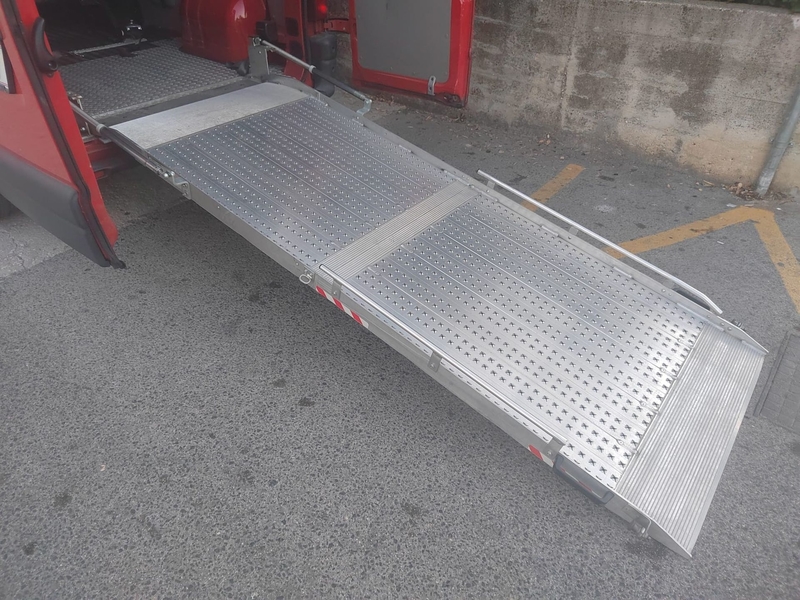
The car passenger mode is used to travel as a passenger in an authorised vehicle while remaining seated in BRO. It is important to distinguish between two types of vehicles when using the car passenger mode (see Figure 75, “Types of vehicles when using the car passenger mode”):
 (a) Lifting platform |  (b) Tailgate |
Vehicles with lifting platform / flatbed vehicles / vans (e.g. Mercedes Sprinter) → Use the car passenger position (see Vehicles with lifting platforms / buses )
Vehicles with tailgate: For vehicles with a tailgate, a relatively steep ramp has to be ascended facing forward. → First use the car passenger boarding mode followed by the car passenger position. See Vehicles with a Tailgate
Boarding vehicles using other boarding aids may be hazardous
Entering vehicles using the car passenger mode was tested on the above-mentioned vehicle types (lifting platform, tailgate). Boarding vehicles with other boarding aids may be hazardous and must be tested thoroughly every time with the assistance of people who will secure the wheelchair. In particular steep folding ramps, ramps with gaps, steps and thresholds can cause the device to topple forwards or backwards.
 |
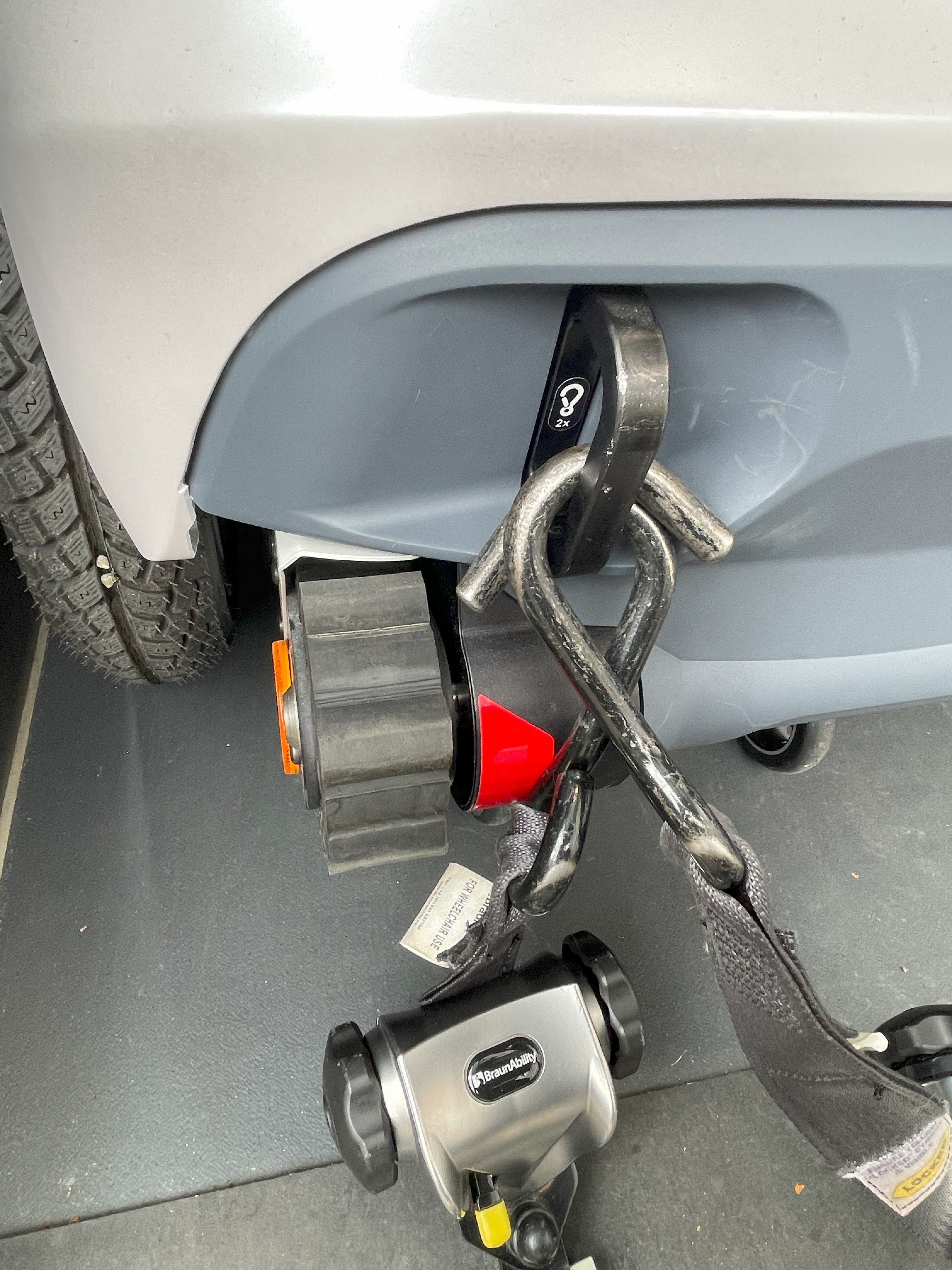
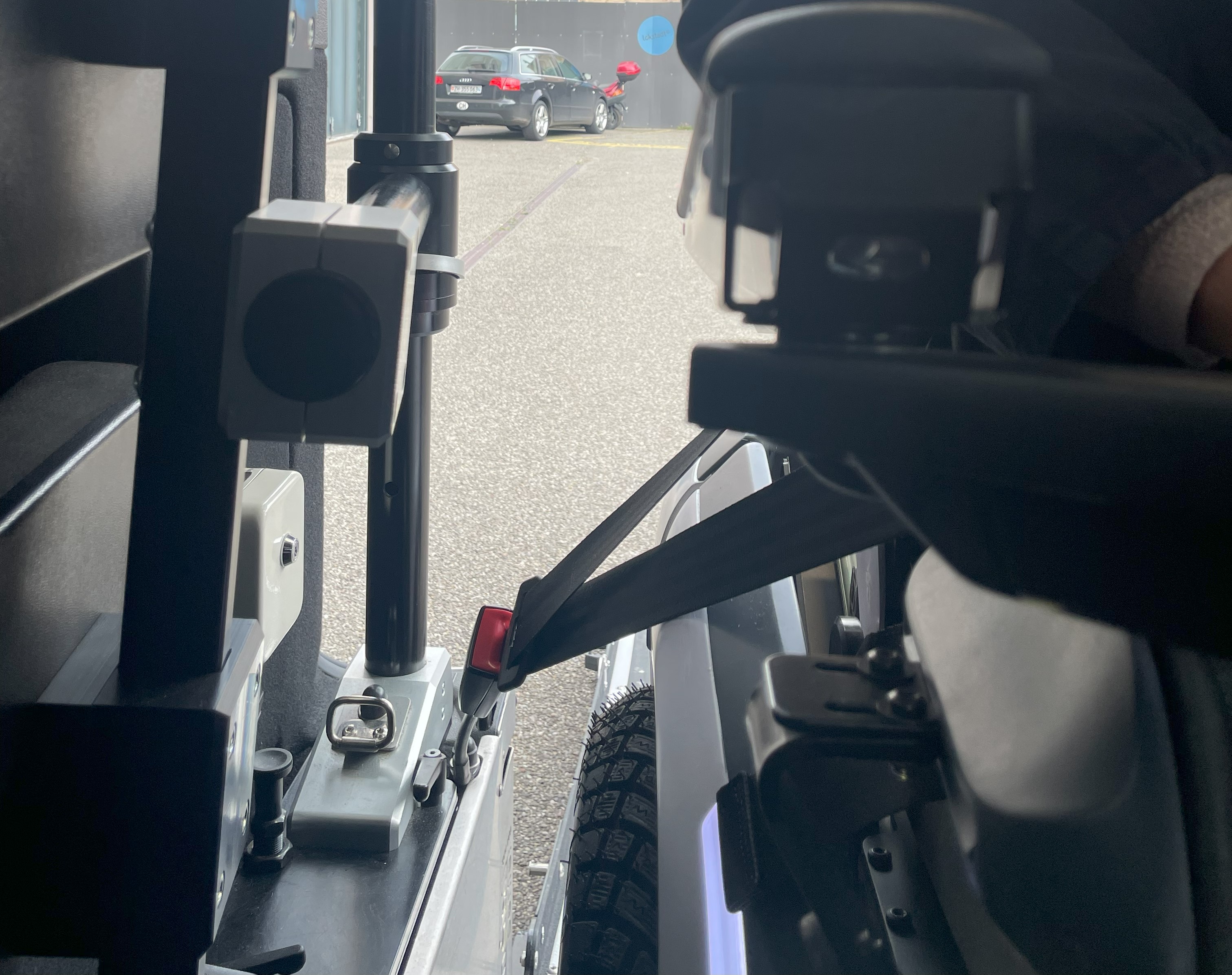
The following images show how the restraint belts are correctly attached to the wheelchair. For the rear securement Scewo recommends four belts (in addition to the two in the front), which comply with ISO 10542-1 and were tested with at least 160 kg each:
(b) Front securement (2x) |
(c) Rear securement (2x) |

General safety instructions for transporting the wheelchair as a car seat for occupants
When used as a car seat for occupants in a motor vehicle, the wheelchair may only be transported facing forwards.
The vehicle must be suitably designed, insured and equipped to transport a person in a wheelchair. If the wheelchair is transported in a vehicle as a car seat with an occupant, the vehicle must meet the requirements of ISO 7176-19:2008 and the straps must comply with ISO 10542-1:2012.
Whenever possible, transfer to the vehicle's designated seating and stow the wheelchair securely in the luggage area. No matter how securely a wheelchair is fastened in the vehicle, it is not designed as a car seat and cannot provide the same level of safety as standard car seats.
Before transport, check that the wheelchair has been secured correctly and that both brakes are locked. Secure the wheelchair to the vehicle at the front and rear only at the securement points (marked by stickers). Follow the manufacturer's instructions supplied with the approved tie-down straps.
Only use wheelchair accessories that are approved for use in a vehicle (e.g. back cushions). Remove any non-approved accessories before transport.
Make sure that no components accidentally press the release button of the belt buckle or the freewheel.
If the wheelchair has been involved in a road traffic accident, return it immediately to the partner or manufacturer for inspection. Safe operation and safety in a further accident cannot be guaranteed.
|
|
The following instructions must be followed when the wheelchair is in car passenger mode:
Use restraint belts that are strong enough and have been tested!
Scewo recommends using a total of six restraints, each with a test load of at least 160 kg (in accordance with ISO 10542-1). Two of these restraints should be attached to the wheelchair's rear securements points on each side before being secured to the vehicle. This is indicated with a “2x” sign on the label (see Figure 5, “Securement point label”). A total of only four restraints are is adequate for many restraint belt manufacturers
such as the pelvic belt do not replace the seat belt!
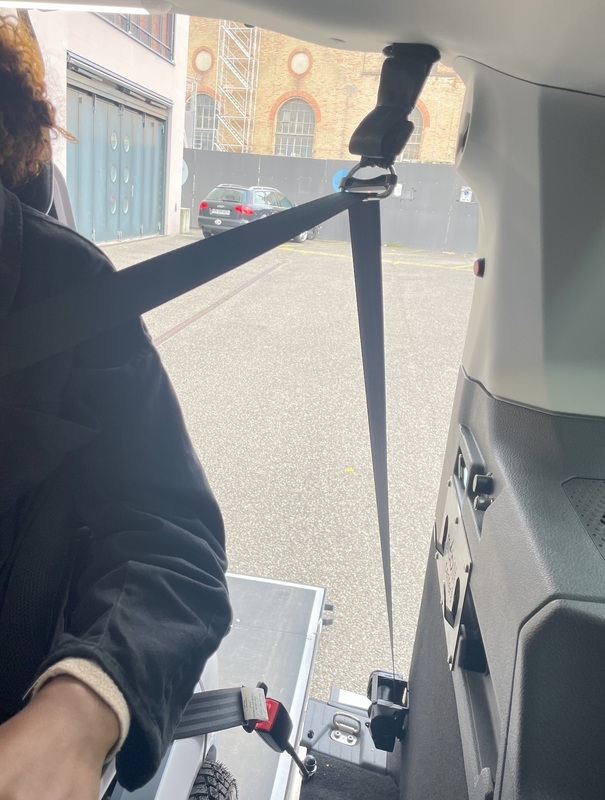
The of the wheelchair are intended to position the user in the wheelchair so that it can be used safely. They offer no protection in a road traffic accident and cannot replace the seat belt installed in the vehicle.
Therefore, always use the restraint systems provided by the vehicle, preferably a three-point seat belt. The pelvic belt integrated in the wheelchair is not approved or designed for use in a vehicle and can tear in an accident!
Never use non-designated securement points
Only use the wheelchair’s labelled securement points to secure it to the vehicle and never use anything else like the wheel or tracks for this purpose. The securements points are indicated as shown in Figure 5, “Securement point label”. Do not modify the securement points and inform your reseller or Scewo if any of them are damaged.
Fasten the seat belt correctly
The correct position of the three-point seat belt is on the inside of the wheelchair's arm support. The three-point seat belt must fit snugly against the user's body with nothing in the way. If the three-point seat belt is not positioned correctly, this can lead to injury and/or death if the vehicle is involved in an accident.
Car passenger mode – use recommended position
It is essential that the wheelchair is in the designated car passenger position. This is indicated when the green car passenger mode icon lights up (see (b) Car passenger position – recommended position [93] ). If the correct positioning cannot be fully achieved, it is not possible to guarantee safety in the event of an accident and the device could detach from the restraints and injure or even kill the wheelchair user or other occupants.
Only use the wheelchair as a seat facing the direction of travel
If the wheelchair is used as a car seat for occupants, it MUST face in the direction of travel. Any other orientation of the wheelchair (e.g. sideways or backwards) is NOT permitted and is life-threatening for the occupant and other passengers.
Unlock front restraint belts before driving out
The front restraint belts attached to the wheelchair must be unlocked (but not removed from the wheelchair) before driving out. Pulling on the locked straps can cause damage to the wheelchair or the attachment system.
Car passenger boarding mode - never use without front restraint belts and a third person (risk of tipping over)
Never use the car passenger boarding mode (see (a) Passenger boarding mode [93]), without two self-locking restraint belts attached to the two front securement points and an assistant standing behind the wheelchair. The assistant must be able to support the wheelchair from behind if required (risk of toppling over backwards).
Secure loose objects, remove smartphone from its holder before driving
Remove your smartphone from the Scewo holder before setting off. In the event of an accident, it could become a projectile and injure other occupants. Remove all other loose accessories or those that are not firmly and safely attached to the wheelchair